

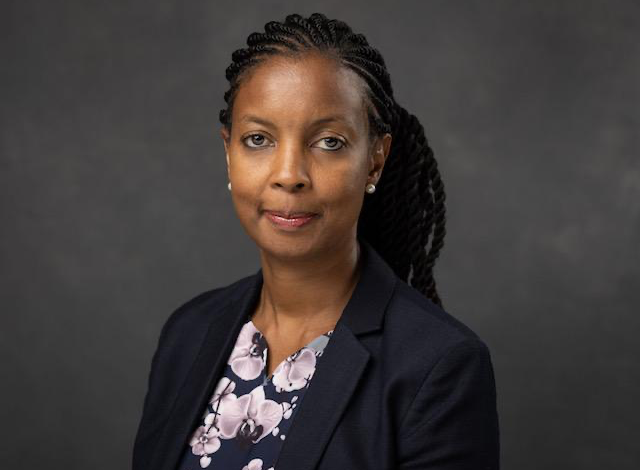
Visa has appointed Anne Kinuthia-Otieno as Vice President and Head of East Africa. She starts on 4 August 2026, will be based in Nairobi, and will run Visa’s business across seven markets. Visa announced the appointment on Thursday 30 July.
That settles a question that had been open for five days. Kinuthia-Otieno wrote on LinkedIn on 25 July that she was leaving Airtel Money Kenya after almost five years as managing director, and that she was starting something new without saying what it was. We covered that exit and the gap it left at Airtel.
First, what this job actually is
Visa does not issue cards and does not hold anybody’s money. It runs a network. Banks, mobile money operators and fintechs connect to that network, issue Visa-branded cards and wallets on top of it, and pay Visa a fee on transactions that travel across it. Running a Visa region therefore means selling to banks, dealing with central banks and signing partnership agreements. Very little of it is visible to the person tapping a card at a till.
Visa divides Africa into clusters. East Africa is one of them and is run from Nairobi. It sits inside a larger group called Southern and Eastern Africa, headed by Michael Berner, whose title in the release is Senior Vice President and Regional Managing Director. Berner had 24 markets when Visa gave him that job in February 2025, and said in May 2026 that 26 countries now sit under him.

Visa’s release does not say which seven markets Kinuthia-Otieno takes on. Visa used to describe this same East Africa cluster as 13 markets. When Chad Pollock took the role in February 2024, Visa named Kenya, Uganda, Tanzania, Rwanda, Mauritius and Ethiopia among them. Part of the difference is a split. Visa now runs a separate Eastern Africa cluster covering Ethiopia, Djibouti and the Indian Ocean islands under Yared Endale, and opened an Addis Ababa office in May 2026 to serve it.
Who she is
Kinuthia-Otieno ran Airtel Money Kenya, the Central Bank-licensed company Airtel carved out of its telco in 2022, from 2021 until her announcement on 25 July. Before Airtel she was at Absa Bank Kenya in products, governance, sales and SME banking, and before that at Barclays in risk. She holds an MBA from Strathmore Business School and a Bachelor of Commerce from Daystar University. Visa puts her experience at more than 20 years.
Visa’s release says she was awarded the Moran of the Burning Spear by the President of the Republic of Kenya. That is the third class of the Order of the Burning Spear, a state honour conferred by the president under the National Honours Act, 2013. The release does not say when she received it or which president conferred it.
Airtel Money’s share of Kenya’s mobile money subscriptions was 3.1% when the Communications Authority first published the split in September 2022. In its most recent report, covering January to March 2026, the figure is 10.9%. Airtel’s own numbers put the customer base at more than five million, up from about 400,000, and the agent network at 170,000 outlets, up from 18,000.
What she is walking into
Cards are a small part of how Kenya pays. Central Bank of Kenya figures for May 2026 show 13.01 million payment cards in the country: 10.59 million debit, 2.08 million prepaid and 339,603 credit. There were 54,600 point-of-sale terminals and 2,221 ATMs. Card payments at those terminals came to KES 297 billion across 61.7 million transactions in the whole of 2025.
Set that against 53.4 million active mobile money subscriptions at the end of March 2026 and 602,470 mobile money agents. The 2024 FinAccess Household Survey found Kenyans still settle 79.8% of daily expenses in cash, and 13.1% through mobile money. Cards trail both.
Visa’s route into that market has largely been through other people’s wallets. The M-PESA GlobalPay virtual Visa card, live since 2022, had 316,500 active users in the year to March 2026, moving KES 12 billion across 8.5 million transactions. We have explained how to set up and use that card, and covered Safaricom quietly adding Fuliza to it in June. Airtel Money’s equivalent product runs on Mastercard, not Visa, following a group deal signed in March 2025 across Airtel’s 14 African markets.
Visa’s July expansion of its Visa Pay software kit named ten African markets and left Kenya out. In December 2025 Uber stopped accepting Visa cards in Kenya and pointed to rising payment processing costs.
Two things happening at Visa this week
Visa told staff on 28 July it is cutting about 2,600 jobs, close to 7% of its workforce, mostly in technology and product teams. Chief Executive Ryan McInerney wrote in the memo, first reported by Bloomberg, that the aim was efficiency and reinvestment. CNBC reported that geographic expansion is one of the areas Visa wants to put that money into. The same day Visa reported net revenue of $11.6 billion for the quarter to 30 June, up 14%. Its standing commitment to the continent is the $1 billion by 2027 it pledged in December 2022.
What to watch
Three things are worth following. Whether Visa names the seven East Africa markets and clarifies Pollock’s position, which it can do at any point. Whether the Kenswitch framework agreement produces an actual product, since a framework agreement on its own launches nothing. And the Communications Authority’s report for April to June 2026, due around September, which is the next hard reading of whether Airtel Money held near 11% after the business she ran raised its M-PESA transfer fees this month.






Join the discussion