
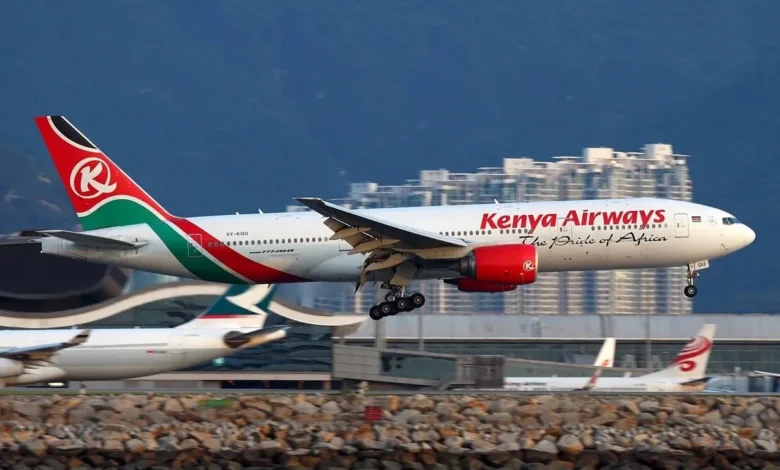
Kenya Airways reported revenue of KES 81.25 billion for the six months to 30 June 2026, up 9% from KES 74.5 billion a year earlier, and a loss after tax of KES 16.08 billion. The loss in the same period of 2025 was KES 12.15 billion, so it has widened by about 32%. The airline published the half-year numbers on 25 August 2026. They are unaudited.
Kenya Airways is Kenya’s national carrier. The government owns 48.9% of it. It flies to 42 destinations, 33 of them in Africa, from its hub at Jomo Kenyatta International Airport in Nairobi, and it is the only African member of the SkyTeam alliance.
The revenue came out of a smaller operation. Kenya Airways flew 9% less capacity than it did a year ago, measured at 6.08 billion available seat kilometres, which is the number of seats flown multiplied by the distance flown. Block hours, the time aircraft spend running, fell 8% to 65,978. The airline filled more of what it did fly: cabin factor reached 76.3%, up 3.9 percentage points. Cargo revenue rose 18% to KES 8.77 billion.
“We experienced largely unserved demand, not an absence of demand, but we are not presenting the external environment as an excuse,” George Kamal, the acting group managing director and chief executive, told a briefing on 25 August. Kamal, a pilot who was previously chief operating officer, has run the airline in an acting capacity since 16 December 2025, when Allan Kilavuka left after six years.

Fuel did the damage
Total operating costs rose 14% to KES 91.9 billion, and the operating loss was KES 10.64 billion against KES 6.24 billion a year earlier.
Fuel was KES 29 billion of that, about 32% of operating costs and 52% of direct operating costs. On the fuel increase itself the company’s own press release and its filing do not agree. The release says fuel costs rose 32%. The reported figures put the rise at 66%, from KES 17.47 billion in the first half of 2025, according to the Nairobi Business Monthly’s reading of the accounts. The 66% figure is consistent with the shilling amounts; the 32% in the release matches fuel’s share of operating costs, which the same paragraph also gives as 32%. Kenya Airways blames the jump on jet fuel prices driven up by the conflict in the Middle East.
Spare parts were the other problem. Kenya Airways says shortages of components and long lead times kept aircraft on the ground. Two have since come back: a Boeing 787-8 returned to service in mid-July 2026, and a Boeing 777-300ER has been redelivered.
The balance sheet got worse. Negative equity widened to KES 147.86 billion from KES 132.07 billion at the end of December 2025, and total liabilities reached KES 328.16 billion against assets of KES 180.3 billion. Acting chief finance officer Mary Mwenga put the debt pile at about KES 152 billion, 90% of it owed to the Kenyan government.
In-flight Wi-Fi now starts going in from 2027
Kenya Airways says fitting its current fleet with satellite internet will cost between USD 20 million and USD 22 million, or roughly KES 2.6 billion to KES 2.8 billion at the CBK rate of KES 129.49 to the dollar on 20 August 2026. That covers hardware and installation only, before the monthly satellite subscription starts.
Installation begins in the second quarter of 2027, one aircraft at a time as each enters the hangar. Long-haul routes go first: London, Paris, New York, China and Amsterdam. Shorter routes follow. One Boeing 777-300ER is already fitted but is waiting on a slot with an internet carrier before the service switches on. Kenya Airways plans to give the Wi-Fi away free for at least the first year and make the money back by selling around the in-flight entertainment system.
That is two years later than the airline said it would happen. When Kenya Airways and Safaricom announced their technology partnership on 6 August 2024, in-flight Wi-Fi was one of the named deliverables and the stated target was 2025. Nothing in the half-year release explains the slip. That partnership also covered baggage tracking, cybersecurity and loyalty, and we have not found a published update on any of those.
The airline has kept shipping the cheaper digital work in the meantime. We covered KQSafari Data, its roaming product with RoamBuddy, in September 2025, and the Visa co-brand cards and Qatar Airways codeshare in July 2025. In May 2026 we wrote about its plan with Rubis to build a sustainable aviation fuel refinery in Nairobi, a project costed at EUR 60 million to EUR 70 million.
What to watch
Chairman Kiprono Kittony, who took the role on 5 March 2026, listed the airline’s priorities as cost control, cash conservation, restoring fleet capacity, cutting debt and finishing the capital raise. The Treasury is trying to sell a stake to a strategic investor and is targeting late in the fourth quarter of 2026. That is earlier than its previous target of the first quarter of 2027. It wants USD 1.5 billion to USD 2 billion and has four candidates in talks.









Join the discussion