

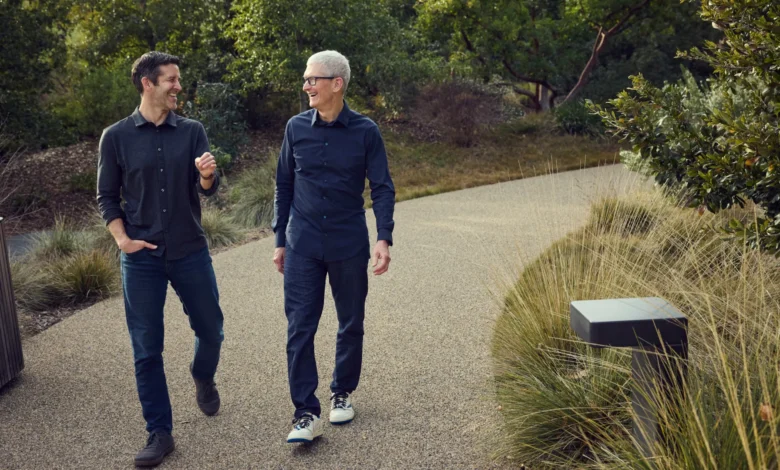
On 1 September 2026, John Ternus officially took the helm as Apple’s Chief Executive, inheriting not just Tim Cook’s former title, but his foundational salary.
However, surface-level salaries rarely tell the whole story in corporate finance. According to an amended Form 8-K filed with the United States Securities and Exchange Commission, Ternus’s annual salary was raised to USD 3 million—the exact figure Tim Cook earned in base salary across 2023, 2024, and 2025.
This reveals a fascinating piece of corporate strategy: Apple chose not to raise the base salary for the Chief Executive role itself. But while their base pay aligns, the architecture of their total compensation reveals two very different roles, risk profiles, and organisational expectations.
The Financial Architecture: Ternus vs. Cook
To understand the scale of these packages, we can look at the target pay set by the board’s People and Compensation Committee.

| Executive | Role | Base Salary | Equity Target | Total Target Pay |
|---|---|---|---|---|
| John Ternus | Chief Executive | USD 3 million | USD 57.5 million | USD 58 million |
| Tim Cook | Executive Chair | USD 2 million | USD 45 million | USD 47 million |
Note: Ternus’s equity is split into a one-off USD 2.5 million restricted stock unit (RSU) award for part-year service in fiscal 2026, and an approved USD 55 million annual award for fiscal 2027. Cook’s new USD 2 million salary takes effect on 26 September 2026.
It is worth noting that Ternus is starting about USD 16 million below Cook’s total 2025 compensation of USD 74,294,811 (which comprised USD 57.5 million in stock and a USD 12 million cash incentive, detailed in Apple’s proxy statement). The recent 8-K filing only covers salary and equity, making no mention of the annual cash incentive plan.
Cook’s new USD 47 million package compensates him to chair the board and run policy work, a transition noted when it announced the handover on 20 April. (For more on his legacy, see our coverage of the announcement and the fifteen-year record on his final day).
The Analogy of Risk: Performance vs. Time-Based Equity
Why are the equity packages structured so differently? Think of the company as a flagship vessel. Ternus is the new Captain actively navigating through storms, while Cook is the seasoned Admiral advising from the port.
- The Captain’s Risk (John Ternus): Three-quarters (75%) of Ternus’s USD 55 million equity is performance-based. These units only vest if Apple’s total shareholder return successfully competes against the rest of the S&P 500. The remaining 25% is time-based, meaning it vests automatically (12.5% every six months over four years) as long as he stays with the company. Ternus carries the lion’s share of the market risk.
- The Admiral’s Reward (Tim Cook): Cook’s USD 45 million is split evenly—50% performance-based and 50% time-based. Because he is no longer the active Chief Executive, the Executive Chair role naturally carries half the market risk. Furthermore, Cook has a specialised retirement clause: if he leaves on or after the first anniversary of the grant date, his shares still settle on their original dates, provided the performance metrics on that half are met.
Conceptualising the Wealth in Kenya
To truly grasp the magnitude of these numbers, we must localise them. Using an exchange rate of approximately KES 129.5 to the dollar on 2 September 2026, the scale is staggering.
- John Ternus: USD 58 million translates to roughly KES 7.5 billion.
- Tim Cook: USD 47 million translates to roughly KES 6.1 billion.
For context within the Kenyan market, we can look at the largest executive package on the Nairobi Securities Exchange. Safaricom’s FY2026 annual report outlines Chief Executive Peter Ndegwa’s total remuneration for the year ending 31 March 2026 at KES 324.5 million. This consisted of:
- A KES 105.4 million salary.
- A KES 118.5 million bonus.
- KES 69.2 million in performance shares.
Despite this being the pinnacle of corporate pay in Kenya, Ternus’s target is about 23 times larger, and Cook’s is 19 times larger.
Ultimately, these eye-watering figures are just targets; they are not guaranteed cheques. The performance units will only pay out if the market and share prices cooperate. The real, finalised figures will be confirmed in Apple’s proxy statement in January 2027. Ternus’s first keynote as Chief Executive is on 9 September.








Join the discussion