
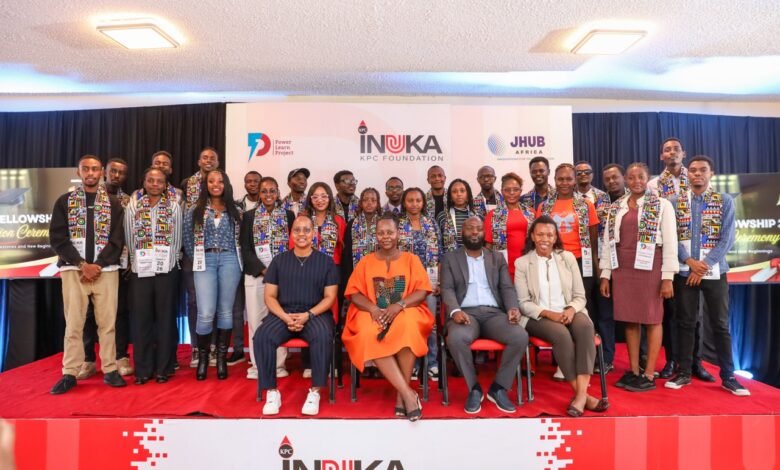
Forty-five young Kenyans graduated from the first Inuka Tech Fellowship at Kenya Pipeline Company’s head office in Nairobi on 19th November 2026. The fellowship is run by KPC Foundation, the charity arm of Kenya Pipeline Company (KPC). It trains recent graduates for free, in data and artificial intelligence (AI) on one track and fibre optic work on another.
KPC Foundation says 60% of the class has already found a job. That’s 27 people. A team of five graduates is also in talks with Family Bank about turning a digital tool they built during the fellowship into a business.
How the fellowship works
The 45 were picked from more than 1,000 applicants, and half of them are women. They didn’t all do the same course, though.
We think 30 of them went through a data and AI track run by Power Learn Project (PLP), a pan-African tech training organisation based in Nairobi that says it has had more than 20,000 graduates since 2021. That track ran for three months and covered Python, machine learning, building dashboards, automation tools and data storytelling, which means explaining what the numbers show to people who aren’t analysts. It wrapped up in September with 30 fellows. You may know PLP from Safaricom Hook, the Safaricom youth platform it partnered on in 2023.

The other 15 trained as fibre optic technicians with JHUB Africa, the innovation hub at Jomo Kenyatta University of Agriculture and Technology (JKUAT). That course runs six months: three months learning to install, splice, test and repair fibre cable, then three months on attachment with fibre operators. It prepares trainees for the Certified Fibre Optic Technician (CFOT) exam, among others.
The fibre track fits a business KPC already has: an underground fibre network of about 1,000 kilometres along its pipeline route, from Mombasa through Nairobi to Eldoret and Kisumu. KPC has started selling access to it and is moving into ready-to-use connections. So it needs people who can build and maintain networks like it, and that’s what the JHUB course trains.
Dr Lawrence Nderu of JHUB Africa says all 15 fibre fellows have industry placements. We think those are the three-month attachments built into the course, which isn’t the same as a permanent job.
What 60% means
Back in September, days before the data and AI fellows finished, PLP’s co-founder Mumbi Ndung’u put the employment rate at 30%. Two months later, KPC Foundation puts it at 60% for the whole class. KPC’s own release has 30% in its headline and 60% in its body.
KPC Foundation hasn’t said what counts as employment. Its manager, Rachel Gathoni, said many of the 45 are “already securing employment, progressing to attachments and apprenticeships or pursuing opportunities to commercialise their ideas”. She didn’t say which of those the 60% covers. Nor has the foundation named the employers, said how many graduates now work at KPC, or said what the Family Bank tool does.
Who can apply next time
PLP’s page asks for a recent graduate in a tech or numbers-heavy field, such as computer science, IT or statistics, with basic knowledge of at least one programming language, who can commit full time. JHUB Africa’s fibre course is open to TVET, diploma and university graduates. At the June launch, KPC Foundation trustee Carol Kiplagat said the fellowship is free and pays stipends. She didn’t give an amount. Both pages have a waitlist for the next intake, and KPC Foundation expects to announce the next class in the coming weeks.
KPC Foundation says it’s talking to partners, Family Bank Foundation among them, to grow the programme. It already runs Inuka scholarships for students with disabilities, which we covered in December 2024 when they were extended to university and TVET.
We think 60% is a strong number for a first class, if those are paid jobs. So the figure to watch when the next intake opens is how many of these 45 are in permanent roles and how many are on attachment.






Join the discussion