
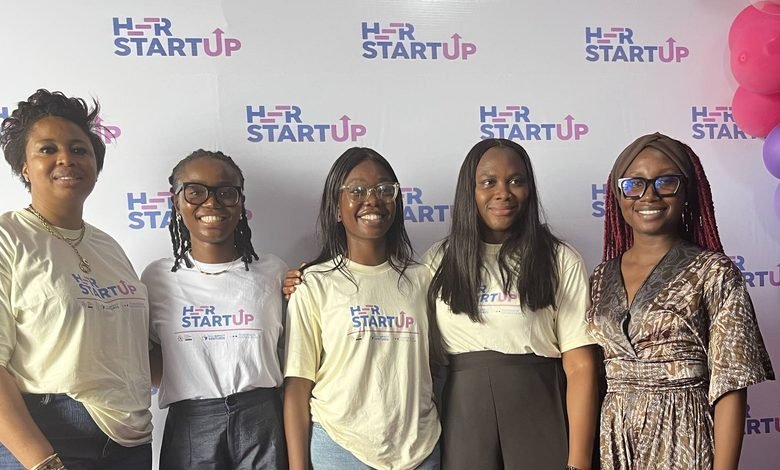
Her Startup, an accelerator for women-led tech companies in Africa, has opened applications for its second cohort. Applications close on 26th October 2026. Ten founders will be picked.
Three organisations run it. Khalil Halilu, who runs Nigeria’s National Agency for Science and Engineering Infrastructure, started KSH Foundation, a Nigerian non-profit. Maggie Gu leads Tomorrow Foundation, a Swiss charity based in Geneva, and Evelyn Castle leads EHA Impact Ventures, a non-profit impact investor that backs women-led businesses in Africa. The training itself comes from Founder Institute, a pre-seed accelerator that runs chapters in more than 200 cities and calls itself the world’s largest.
If you’re a woman running a tech business anywhere in Africa, here’s what you’d be applying for.
What you get
Training comes first. Selected founders go through the Founder Institute accelerator, and Her Startup pays the fees. Founder Institute normally charges an entrance fee, which for its Abuja chapter is USD 249 early and USD 549 later. The course is intense. Her Startup’s own FAQ says to plan for at least 20 hours a week while it runs.

Then there’s a stipend, so you can spend those 20 hours on the course instead of chasing money. The release calls it a monthly stipend. The programme’s site puts it at USD 1,000, and ties it to participation and performance. Founders also get free therapy sessions through Blueroom Care, a Nigerian online counselling service.
Then the money, which is where Her Startup differs from most programmes we cover. Founders who finish the training pitch to an investment committee. The release doesn’t say how much is on the table, but the programme site says up to USD 5,000, or about KES 649,000, and that is what each of the three winners got in the first cohort. Finishing the course doesn’t guarantee funding; only the pitch winners get it.
The money isn’t a grant, which is what most programmes like this hand out. It’s a loan, a convertible, revenue-based one. A normal loan has a fixed repayment every month whether you sold anything or not. A revenue-based loan is repaid as a percentage of what you actually earned that month. So in a slow month you pay less, and in a good month you pay more. That’s why it suits a business that is six months old and still finding its customers. The convertible part means that if the company later raises a bigger round, the lender can swap what is still owed for shares instead of waiting for repayments. Her Startup says repayments go back into the pot to fund the next cohort.
So if you win, you get about KES 649,000 that you repay from sales, and you keep all your shares unless the business grows enough for the loan to convert. Not every founder wants that: of the three winners in the pilot, one declined the loan terms and two accepted.
After the money comes mentoring matched to your sector, plus access to Founder Institute’s network of mentors and investors.
Who can apply
You need to be a woman founder, co-founder or CEO aged 18 to 35. The business must be tech-enabled, with a product already on the market, and it must have been running for at least six months with at least USD 500 in monthly gross revenue, or about KES 64,900. Only one person per startup takes part. Any African country qualifies, and the programme is asking founders from Francophone Africa in particular to apply. Its selection criteria reserve at least 15% of places for Francophone Africa and cap fintechs at 20% of the cohort. There is no application fee, and you apply at apply.her-startup.com.
What the first cohort got
The pilot ran from late 2024. More than 200 founders from 18 countries applied, and ten were picked for training, from Nigeria, Kenya and Tanzania. The pitch day was in Lagos on 10th April 2025. The three winners were Dynalimb Technologies, PocketLawyers and Ploutos Page. Dynalimb makes 3D-printed prosthetic limbs, PocketLawyers sells software to law firms, and Ploutos Page does bookkeeping for small businesses.
Blessing Aniefiok, Dynalimb’s chief operating officer, says customer numbers and sales have risen since the programme. The second edition adds an orientation session before training starts and clearer guidance for participants, which reads to us like the pilot’s founders found the start rough.
The release also doesn’t say whether Her Startup covers Founder Institute’s equity pledge. Founder Institute asks every founder it trains to pledge 2.5% of future equity to its mentors, its local chapter leaders and Founder Institute itself, which kicks in only if the company later raises USD 100,000 or more from outside investors. Her Startup says it covers the fees. It says nothing about the pledge.
Then there is the funding gap that justifies the programme. The release says women founders got less than 1% of the “more than $2 billion” African startups raised in 2025. The figure it links to is Africa: The Big Deal, which counts USD 3.2 billion for 2025, or about KES 415 billion. Less than 1% of that went to startups founded only by women, 8% to teams with at least one woman, and 91% to all-male teams. Companies with a woman as CEO got 2.2%, the lowest share since the database started in 2019. The gap is real, the release just understated the total it is a share of. The 58% figure for women’s share of Africa’s self-employed is the programme’s own number, and neither the release nor its site says where it comes from.
Our take
We’d apply, with eyes open. Earlier this month, seven Kenyan women-led startups got KES 9 million in grants from Standard Chartered Foundation’s Women in Tech accelerator, about KES 1.29 million each and equity-free. Her Startup’s cheque is half that and it has to be repaid. What you get instead is a 14-week course that would otherwise cost you up to USD 549, a stipend while you do it, and a loan built for a business that doesn’t yet have steady sales. For a founder in Nairobi or Kisumu who is past the idea stage but too early for a venture round, that is a reasonable trade. Ask about the equity pledge and the mentoring length before you sign anything.









Join the discussion