


Satlyt, a startup that writes software for satellites, has raised USD 8 million in seed funding. That’s about KES 1.04 billion. The round was led by non sibi ventures, a venture capital firm, and TLCOM, Antler, Launch Africa Ventures, Enza Capital, Slauson & Co. and Axian Investment are among the other investors.
Satlyt announced it on 1st October. This week the company is in San Francisco as one of the startups pitching at TechCrunch Disrupt’s Startup Battlefield.
Rama Afullo, a Kenyan-American engineer, started the company in 2024. He worked in Google’s cloud business and then, briefly in 2024, on Starlink, SpaceX’s satellite internet service. He has said he pitched the idea inside both companies and both said no. Satlyt’s US headquarters is in Sunnyvale, California. Its Africa headquarters is in Nairobi, where it has a Kenyan subsidiary and a big part of its engineering team.
What the software does
A satellite that photographs the Earth can’t send everything home as it collects it. It only talks to the ground when it passes over a ground station, and that link is slow. So images and system logs queue up on board waiting for the next connection, and the people who need the data wait with them.

Satlyt’s software does the processing on the satellite’s own computer, so the spacecraft sends down a result instead of every raw file. Its first work in orbit came in March, when it ran two missions. The first uploaded software to a Rogue Space satellite. The second ran a troubleshooting tool built on Gemma, Google’s small open AI model, on a Momentus spacecraft. When the team planted software errors on purpose, the model read the logs and sent down a 469-byte diagnosis in place of 1,319 bytes of raw logs, about 64% less. So an operator spends less of its scarce link time on raw files and gets the answer sooner.
The company has no satellites of its own. Its software runs on computers other companies have already put in orbit. Starcloud and Google, which also want to run computing in space, have each put their own hardware in orbit. Starcloud’s satellite went up in November 2025 with an Nvidia H100 chip on board. Google’s Project Suncatcher prototype, built with Planet, went up on 1st October on Transporter-18. That’s a SpaceX rideshare flight, meaning one rocket carries satellites for many customers.
Satlyt’s next test flew on that same rocket. Two applications are meant to run on MOI-1a, a satellite built by Indian startup TakeMe2Space: research software from Satlyt’s NASA work with the University of Houston, and an imagery app from a commercial software company. Satlyt says launch and a successful run “are separate milestones”. It hadn’t published results by 14th October.
The “virtual AI data centres” in Satlyt’s pitch come later. The idea is to link the computers on satellites owned by different companies so they can share big jobs, the way a data centre on the ground spreads work across many servers. Satlyt says its current work is on single spacecraft, and that the October deployment “does not yet demonstrate computing coordinated across multiple spacecraft.”
What the USD 4 million from NASA is
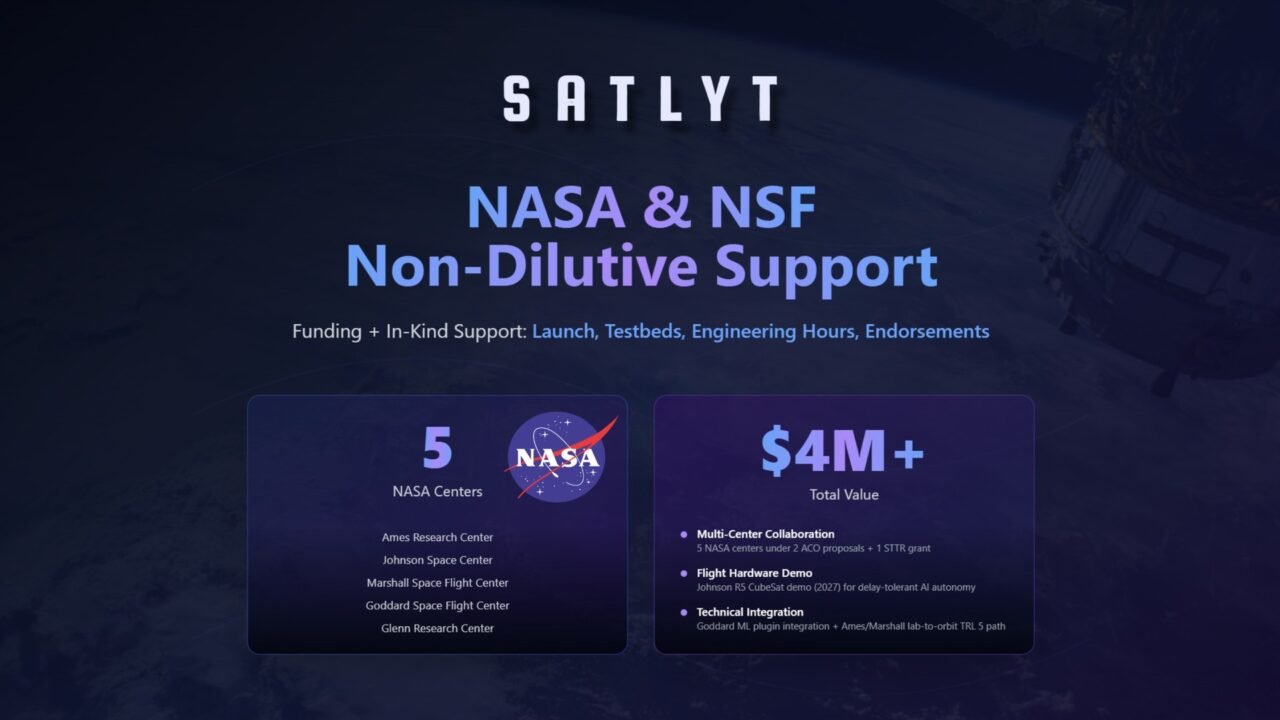
In November 2025, Satlyt announced USD 4 million in NASA support, or about KES 519 million. Its own post breaks that figure into three parts, and only one of them is money paid to Satlyt.
The cash is a Small Business Technology Transfer (STTR) contract, a US programme that pays small firms to do research with a university or research lab. The federal contract record shows NASA signed it on 16th September 2025 and has committed USD 179,529, about KES 23 million, for work running until 28th October 2026.
USD 3 million, about KES 389 million, is what Satlyt calls “civil service support”: the time of NASA staff at four NASA centres, under a programme NASA says works “without the exchange of funds”. The last USD 850,000, about KES 110 million, is a follow-on Phase II contract Satlyt said it was preparing for. The federal record shows no Phase II award. NASA’s cash commitment to Satlyt so far is about USD 180,000, or about KES 23 million, and the rest is NASA staff time and a contract Satlyt hopes to win.
The Kenya and Angola agreements
Satlyt signed a memorandum of understanding (MoU) with the Kenya Space Agency in April 2025, at the NewSpace Africa Conference. It signed a second one in June 2026 with GGPEN, Angola’s national space programme office, at the ANGOTIC technology conference in Luanda. An MoU records that two parties intend to work together. No contract or budget has been announced under either MoU.
Kenya’s own space programme is still small. Taifa-1, an Earth observation satellite designed by Kenyan engineers and built by Bulgaria’s EnduroSat, went up in 2023, and earlier this month we reported that the agency and the Treasury had signed up to a feasibility study for a spaceport at Kipini.
Satlyt has the investors’ money and two small runs in orbit behind it. The shared computing across satellites and any work with the Kenya Space Agency are still plans. What Kenya has today is a satellite software team in Nairobi. The MOI-1a results are next, and the NASA contract ends on 28th October with no Phase II award on record.








Join the discussion