
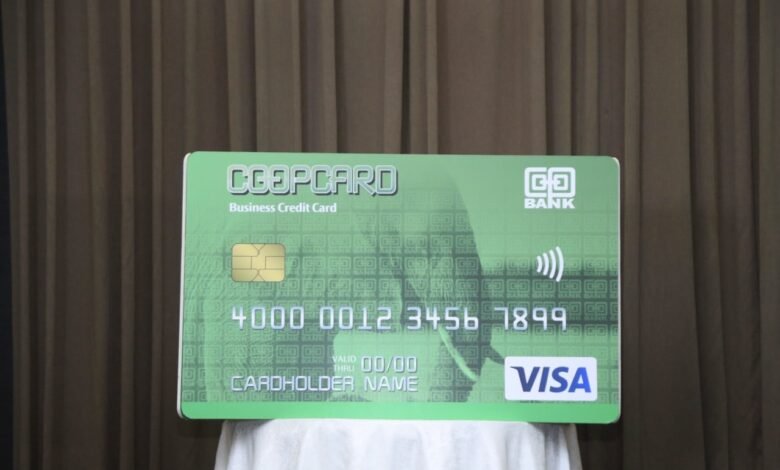
On 1 July 2026, Visa announced new tools that let small businesses accept and send money straight from a smartphone, framing the phone as “the new cash register”. For Kenya, the relevant detail sits lower in the announcement: Co-operative Bank of Kenya is set to switch on one of those tools, Visa Accept, “in the coming weeks.”
That would make Co-op the latest Kenyan bank to turn an ordinary phone into a card machine. It is not the first, and the technology behind the launch is already live in the country. Separating the tool from the marketing shows what changes for the average trader, and what does not.
What Visa Accept does
Visa Accept turns a merchant’s own smartphone into a payment terminal. A shopkeeper opens their banking app, keys in the amount, and the customer taps a contactless Visa card, or another phone, against the back of the merchant’s device. The near-field communication (NFC) chip inside the phone reads the card. Money reaches the merchant’s Visa debit or prepaid account close to instantly, with the fraud and dispute protections that come with any Visa card payment. There is no separate card machine, no dongle, and no monthly terminal rental.
The industry name for this is SoftPOS, software that stands in for point-of-sale hardware. Visa brands its version Tap to Phone, and it runs on NFC-enabled Android phones. iPhones are not part of it, because that would require Apple Pay, which is still not available in Kenya. We set out that gap in full when Apple launched its own Tap to Pay in South Africa.

Visa paired the launch with an update to Visa Direct, its payouts rail. The pitch is that the same phone a trader uses to get paid can also send money out, to staff, suppliers or as refunds, and across borders. Visa’s global version of the release also names a third product, Visa Pay, which plugs mobile wallets into the Visa network. The copy written for Africa and the Middle East, quoting Visa’s regional head Shahebaz Khan, dropped Visa Pay and led with the Kenya and Ghana rollouts instead. Visa’s stated reason for all of this is financial inclusion: it cites World Bank data showing that of the 1.3 billion adults worldwide without a financial account, about 530 million already own a smartphone.
Co-op is joining a race, not starting one
Co-operative Bank is one of Kenya’s three largest banks by market share, serves around 15 million customers, and is built on the country’s savings and co-operative (SACCO) movement. Adding Visa Accept gives the product a wide distribution network overnight. But the same tool is already running in Kenya under other names.
KCB launched the identical Visa Tap-to-Phone service in December 2025, on the same Visa Acceptance Platform. Before that, Absa had been offering smartphone card acceptance to SMEs since 2023 through its Mobi Tap product. Fintechs are in the mix too. Pesapal has sold smartphone-based acceptance to small traders for years. Co-op is the newest name on the list, not the trailblazer. The contest now runs between banks, between Visa and Mastercard, and between all of them and Kenya’s payments incumbent.
The M-Pesa question
In most countries, “your phone is now a card terminal” is a real leap, because small traders previously had no cheap way to accept digital money. Kenyan traders already do, and that changes what Visa Accept is for here.
Around 1 million businesses now take payments through Lipa na M-Pesa, and M-Pesa passed 40 million monthly active users in March 2026. Any trader with any handset, including a basic feature phone, can accept money through a till or paybill number. There is no NFC, no card, and nothing for the customer to download. By contrast, the whole country had just 54,454 card POS machines at the end of 2025, per Central Bank of Kenya data, and cash still accounts for roughly 80% of daily transactions, by FSD Kenya’s estimate.
Visa Accept is not going to displace M-Pesa at the kiosk. Its real value in Kenya is narrower: accepting cards. That covers the growing base of contactless local cards, corporate cards, and the Visa and Mastercard cards carried by foreign tourists who do not have M-Pesa. A curio seller, a tour guide or a beach operator can take an international card without sending the customer to find an ATM. The same tourist-payment logic sits behind government-backed apps such as TouristTap. Think of Visa Accept as a bridge between the global card network and merchants who were priced out of card acceptance, rather than a rival to the mobile-money rails those merchants already run on.
Why the banks want in
For a bank, SoftPOS is cheap to distribute. The merchant already owns the phone, so signing up a new card-accepting business costs the bank almost nothing in hardware. It deepens the bank’s ties to small-business customers, and it feeds the wider push, backed by the Central Bank, to bring more of the informal economy into formal records. Visa has been steadily widening its Kenyan footprint through deals like this, including a recent agreement with Kenswitch to modernise the country’s shared payment infrastructure. Mastercard is chasing the same merchants. The card networks and M-Pesa are also converging rather than simply fighting: M-Pesa is bringing its own tap-to-pay feature to Kenyan phones.
What to watch
Co-op has not confirmed its own launch date or published any merchant fees, so the “coming weeks” timeline is Visa’s word, not the bank’s. Three things are worth tracking. First, whether Co-op goes live in the window Visa named. Second, what it charges merchants per transaction, because that is what decides whether a trader reaches for a card tap or an M-Pesa till. Third, whether phone-based acceptance finally pushes card payments past the formal corridor of supermarkets, hotels and fuel stations where they have always sat.
For most Kenyan traders, M-Pesa still does the job it always has. Visa Accept matters most for the businesses that need to take a card, and for the banks racing to sign those businesses up before their rivals do.






Join the discussion