
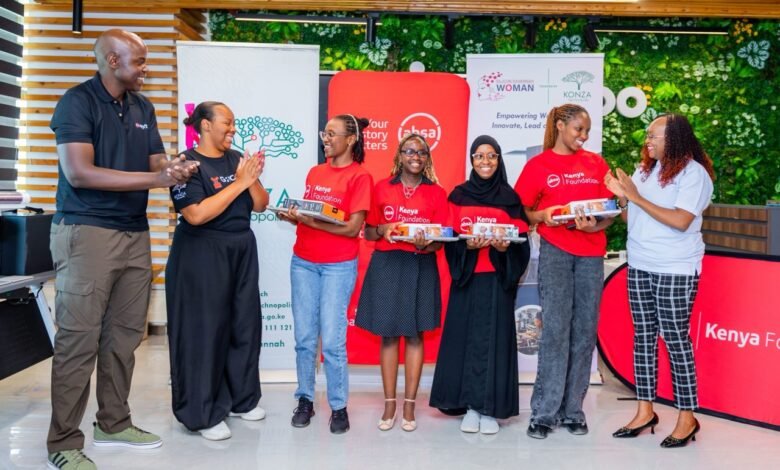
A team of four young women has won this year’s GirlCode Kenya Hackathon with Naulisako, an app that collects fares on public transport and keeps the books for the vehicle’s owner. Mary Wangui, Linet Mugwanja, Aisha Barasa and Cynthia Chepkorir built it over the weekend of 3rd and 4th October 2026 at Konza Technopolis. Konza is the government’s smart city project on the Nairobi-Mombasa road. The organisers announced the results on 6th October.
GirlCode is a Pan-African social enterprise, founded in 2014, that runs coding programmes and hackathons for women. A hackathon is a contest where teams get a fixed stretch of time, here two days, to build a working version of an idea and then pitch it to judges. The Kenya edition, the third, had 44 participants: students, recent graduates, developers and women who want to start a business. Absa Bank Kenya, now in its third year as a partner, sponsored it, and the Technopolis Development Authority, which runs Konza, hosted it and supplied mentors.
What Naulisako does
Nauli is Swahili for fare, and the problem the team picked is one most Nairobi commuters will recognise. Many matatus already take fares on M-Pesa, through a till or phone number displayed inside the vehicle, as we found riding them in Nairobi last year. That makes paying easier for passengers, but it doesn’t tell the owner, who isn’t on the bus, how many people rode and how much they paid. So at the end of the day the owner ends up matching what the crew says it collected against what arrived in the account. That matching is called reconciliation.
Naulisako takes the fare, does that reconciliation automatically and keeps sales records. The team says the aim is to make payments “more efficient, transparent, and accessible”. For an owner, that would mean seeing a matatu’s takings without relying on the crew’s count.

The announcement calls the app AI-powered but doesn’t say what the artificial intelligence does, how passengers pay (M-Pesa, a card or something else) or what it would cost an owner. We found no website or App Store listing for Naulisako. That is normal for something built in two days, so Naulisako is still a prototype you can’t use on your commute yet.
Kenya has tried to take cash out of matatus before. Card schemes such as BebaPay, which Google ran with Equity Bank, never caught on with operators, and Google shut BebaPay down in March 2015. M-Pesa worked where the cards didn’t because passengers already had it. Naulisako goes after the part M-Pesa leaves to the owner, the record-keeping.
The other winners, and what comes next
The Bots team came second with Biashara Bot, which keeps financial records for small businesses that have no bank account. Korva came third with Korva Creatives Economy, a platform that puts a creator’s income, audience numbers and money earned from their content rights across different platforms in one place.
The top three teams went home with laptops, tablets, Bluetooth speakers, headsets and books. Naulisako is also in line for a bigger prize, because every first-place team in GirlCode’s 2026 hackathon series goes through to a Pan-African final. Kenya was the sixth and last stop, after South Africa, Botswana, Uganda, Ghana and Tanzania. The Pan-African winners will be announced on Monday 12th October 2026. The winning team gets R100,000, or about KES 783,000 at 7.83 shillings to the rand on 8th October 2026. The winning small business gets six months in an accelerator programme, a course of support to refine its prototype, strengthen its business model and grow.
If Naulisako wins on Monday, the team gets the cash. Whether it ever reaches a matatu depends on a Sacco, one of the co-operatives that matatu owners belong to, agreeing to try it, and nothing in the announcement says one has.





Join the discussion