
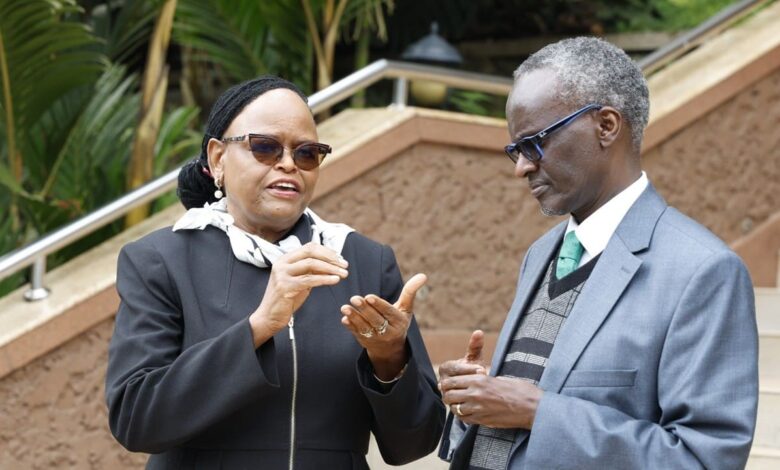
When Chief Justice Martha Koome recently revealed the Judiciary’s plans to integrate artificial intelligence (AI) into court operations, the focus was on the new policy framework in the works. But in her own words during the same event, Koome shared a behind-the-scenes story that’s just as telling: AI is already quietly at work in Kenyan courtrooms, and it’s been learning fast.
“Let me confess here, our transcription is majorly done by AI,” CJ Koome said with a smile. “AI, when we started, could give us 30% correct of transcription because AI doesn’t know us, doesn’t know our accent, and doesn’t know our intonations.”
In other words, when the Judiciary first tested AI for court transcriptions, it got more wrong than right at a 70% failure rate. And the culprit wasn’t laziness or poor tech. It was the uniquely Kenyan blend of accents, intonations, and courtroom phrasing that global AI models had never been trained on. But as anyone familiar with machine learning knows, AI improves with more exposure and better data. In this case, every transcript fed back into the system became part of its learning diet. The results? A huge leap from 30% to 80% transcription accuracy.
“AI is very clever by now,” Koome quipped. “It’s getting our transcription at 80% correct. I don’t know who is AI because we can even clap for AI.”

The improvement underscores why the Judiciary is now doubling down on AI, not for judgment writing, but for “organizing our information and also in transcribing,” as the CJ clarified. Beyond that, the technology will be explored for case management, legal research, predictive analytics, and administrative support; all under a strict policy framework to protect judicial independence, data privacy, and due process.
While Koome didn’t say how long it took AI to improve its transcription accuracy, AI’s rapid learning curve suggests it wasn’t years. And in a justice system where speed and accuracy are critical, such a gain is more than just a tech upgrade. It’s a practical case study in how AI, once adapted to local realities, can actually work for Kenyan courts.








Join the discussion