

When Savanna Fibre first popped up on our radar promising a jaw-dropping 100Mbps connection for just KES 2,000, it shocked the Kenyan internet market. To many, it sounded too good to be true. The biggest hurdle at the time was availability; everyone wanted a piece of the pie, but the service footprint was painfully limited to Kilimani, Kileleshwa, Langata, Muthangari, and Lavington in Nairobi. Fast forward to today, and the upstart ISP is aggressively rolling out its infrastructure across Nairobi and its environs, bringing “twice the speed at half the price” to new doorsteps.
If you’ve been waiting to ditch your current provider, here is everything you need to know about Savanna Fibre’s expanded coverage, what current users are saying, and the undeniable ripple effect they’ve triggered across the industry.
Where is Savanna Fibre available?
According to the latest rollout updates, Savanna Fibre has officially gone live in several key residential hubs. If you reside in any of the following areas, you can now get connected:
- Nairobi area: Brookside, General Mathenge, Kileleshwa, Kilimani, Lang’ata, Lavington, Muthangari, Parklands, Raphta Road, Roysambu, and Westlands.
- Kiambu and outskirts: Garden Estate, Kamakis, Ruaka, and Thindigua.
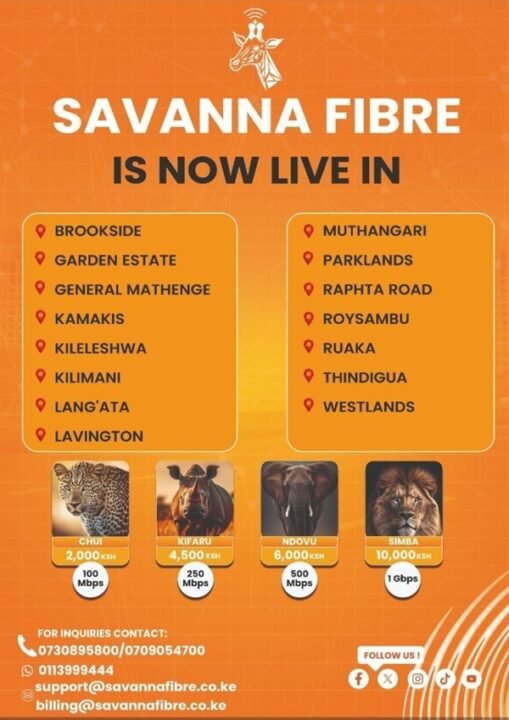
Their pricing tiers, cleverly named after the Big Five and other iconic wildlife, remain aggressively competitive. They offer unlimited internet, a free router, and zero installation fees across all packages:

- Chui (100Mbps) – KES 2,000
- Kifaru (250Mbps) – KES 4,500
- Ndovu (500Mbps) – KES 6,000
- Simba (1Gbps) – KES 10,000
What are Kenyans saying about Savanna Fibre?
We have scoured the web and talked to current users, and the consensus is overwhelmingly positive, but with a few notable caveats.
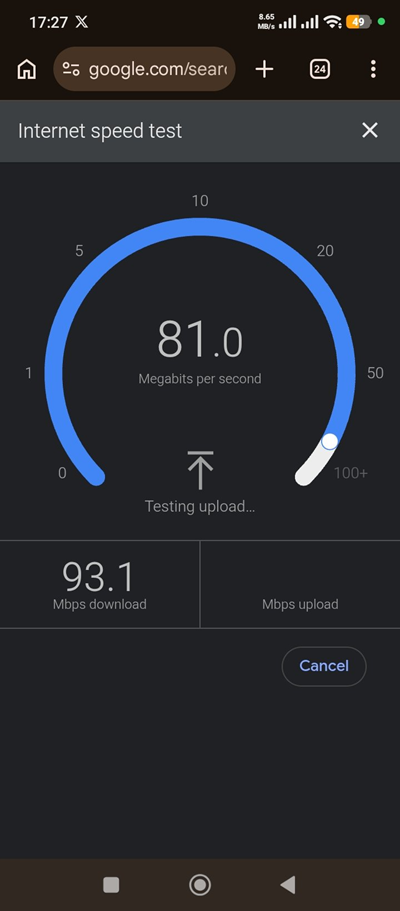
Customers are genuinely impressed by the raw speeds. Recent speed test results shared by users show actual download speeds hitting an impressive 93.1 Mbps and upload speeds around 81.0 Mbps on the baseline KES 2,000 plan.
“I have had it for 2 months now. It’s worth every shilling,” noted Comolor on X, who praised the network’s gaming performance. “Consistent speed and 70 ping on games like Valorant and 40-30 on COD. I would suggest everyone gets it.”

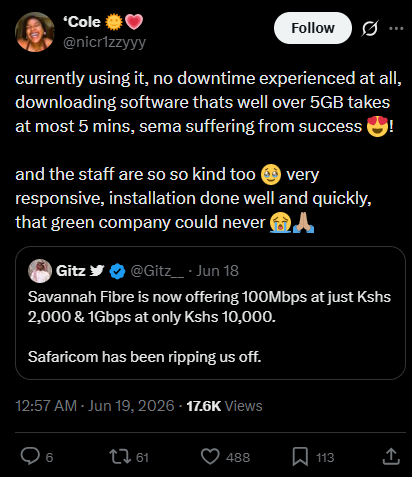
Other users echoed the sentiment, praising the customer service. “Currently using it, no downtime experienced at all. Downloading software that’s well over 5GB takes at most 5 mins, sema suffering from success!” shared Cole. “And the staff are so kind too, very responsive. Installation was done well and quickly, that green company could never.”
Others also attested to the reliability, with one business account adding, “We tried Zuku, Airtel, and Jamii before we gave Savannah a try in April. Best decision ever.”
However, it is not entirely a flawless utopia. Some power users have pointed out latency issues and evening throttling. One user cautioned, “Safaricom Home Fibre is still superior if you want low latency and online gaming. Savannah has very high latency, and I’ve used it for months. The 100Mbps speed is never a 100 but usually at like 40Mbps or, when better, 80Mbps. You will experience downtimes when demand is high from 6 PM onwards.”
Is this Savanna Fibre’s honeymoon phase?
I think Savanna Fibre is currently in its honeymoon phase. Right now, they are delivering on their promise largely because they are a new service dealing with a relatively small, localized pool of subscribers. Their bandwidth pipe is wide open, and the customer support team isn’t bogged down by thousands of daily tickets.
The real acid test will come when thousands or millions of Kenyans join the party. Network congestion is the ultimate equalizer in the ISP world. When every household in Nairobi, Mombasa, Kisumu, and Eldoret is streaming 4K Netflix, downloading huge files, and gaming at 8 PM, we will finally see if Savanna’s backend infrastructure can take on the big boys.
Remember, even Elon Musk’s Starlink had to freeze new registrations in Nairobi when they realized their bandwidth was getting overwhelmed by sheer demand. They only resumed sign-ups after upgrading their infrastructure to handle the capacity seven months later. Savanna Fibre will inevitably face this exact growing pain. We have to give it up to them for doing a stellar job right now, but we will be watching closely to see how they scale.
Savanna Fibre is the catalyst we desperately needed
Whether you plan to switch to Savanna Fibre or not, you are already benefiting from their existence. Their aggressive entry into the market was the undeniable catalyst that woke up the sleeping giants.
Just look at the recent industry shifts: Safaricom revamped its Home Fibre speeds and introduced new Lite/Bamba plans. Zuku quietly doubled its home internet speeds to keep pace. Starlink just waived its ridiculous activation fee for the Mini kit, Faiba introduced cheaper entry-level plans, and Airtel Kenya fully entered the fixed broadband market with its Xstream Fibre plans.
Competition is the consumer’s best friend. Savanna Fibre has disrupted a stagnant market, and while I know the honeymoon phase might eventually level out, I genuinely hope they sustain this momentum. Because at the end of the day, all we want is the best, most affordable internet for everyone in Kenya. And right now, Savanna is making that dream a reality.







Join the discussion