
Kenya’s smartphone story is less about specs and more about access. Not who has the most powerful device, but who finally gets connected. That’s why one figure buried in Vodacom Group’s FY2026 integrated report for the period ending March 2026 stands out: around 700,000 devices were assembled in Kenya in just one year at the East Africa Device Assembly plant.
The plant, launched in 2023 as a Safaricom-led joint venture with Jamii Telecoms, Chinese OEM Lel Technology and Industrial Technology Training Company Limited, is now being positioned as a core pillar in Vodacom’s wider digital inclusion strategy. And it’s not just symbolic. The numbers show a serious attempt to shift how affordable connectivity is built and delivered in the region.
According to the report, the facility has an annual capacity of 3 million units and produces smartphones, educational tablets, and Know Your Customer (KYC) devices. These are not niche products. They sit at the centre of how people access mobile money, education platforms, and digital identity systems.
In Kenya, the East Africa Device Assembly plant, launched in 2023 as a joint venture involving Safaricom, assembled around 700,000 devices, including smartphones, educational tablets and Know Your Customer (KYC) devices. With an annual capacity of 3 million units, the facility is central to our digital inclusion strategy, retailing 4G-enabled smartphones for as little as US$50 (KES7 499) to empower underserved communities. This initiative has resulted in reduced costs of up to 30% and created 300 local jobs.

~ Vodacom Group, FY2026 Integrated Report
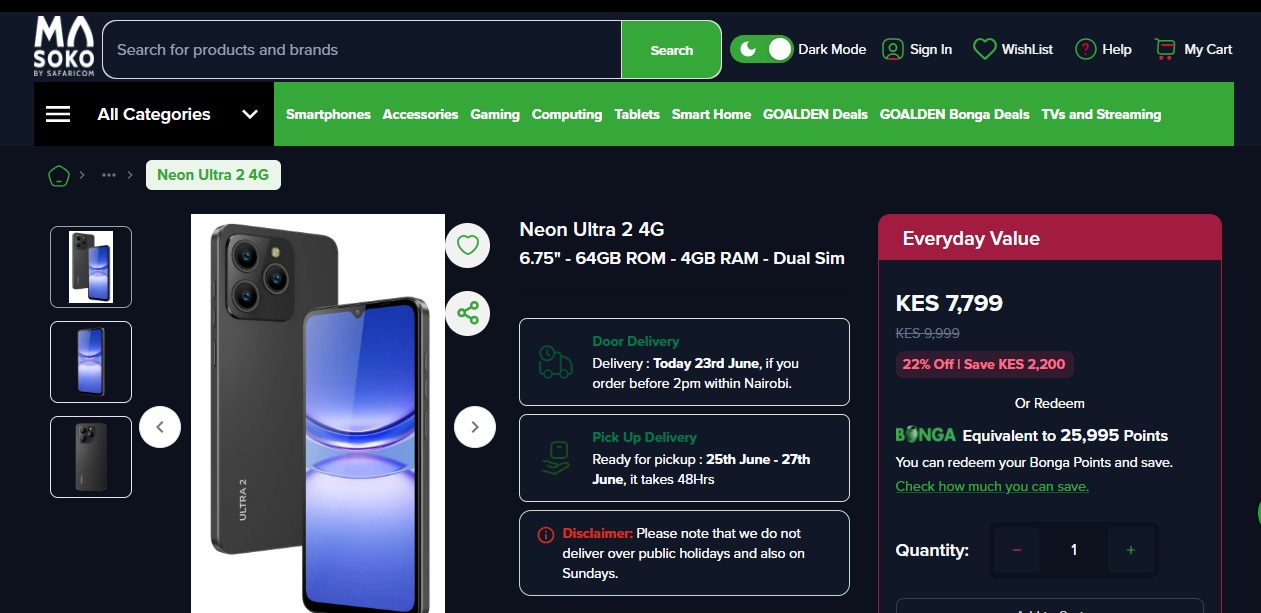
What makes this more interesting is pricing. Vodacom says the factory is already enabling 4G smartphones to retail for as low as US$50. And indeed, a quick cross-check on Safaricom’s Masoko confirms this to be the case for the Neon Ultra 2 4G, which is currently going for KES 7,799, with others going for much cheaper.

The company also says local assembly has reduced device costs by up to 30%, while creating about 300 local jobs.
Vodacom’s report also expands the picture beyond Kenya. The group says it is supporting local smartphone assembly in Egypt, Ethiopia, and South Africa, alongside partnerships with global manufacturers. Across these markets, it is pushing entry-level smartphones priced between US$20 and US$40, designed with long battery life and essential apps like WhatsApp, Facebook, and YouTube.
Through local assembly initiatives in Kenya, Egypt, Ethiopia and South Africa, and partnerships with original equipment manufacturers (the specialised companies that manufacture hardware to our specifications), we introduced affordable models ranging from US$20 to US$40. These devices feature long-lasting batteries and essential tools like WhatsApp, Facebook and YouTube.

~ Vodacom Group, FY2026 Integrated Report
But Kenya’s case stands out because of scale and timing. The EADAK plant sits at the intersection of telecoms, manufacturing, and digital services, and it directly feeds into Safaricom’s broader ecosystem, where devices, connectivity, and mobile money increasingly overlap. When compared to Egypt, though, we still have some catching up to do.
Egypt’s smartphone ecosystem is undergoing a shift towards the localisation of smartphone manufacturing, supported by the national device identity registration framework. More than 15 global smartphone brands have established local manufacturing and assembly operations in Egypt. This growing ecosystem is increasing device availability, enhancing portfolio diversity, improving affordability and accelerating smartphone penetration across the country.

~ Vodacom Group, FY2026 Integrated Report
So while 700,000 units may sound like a production milestone, the bigger story is what it unlocks: cheaper entry into the digital economy for millions who were previously priced out.








Join the discussion