
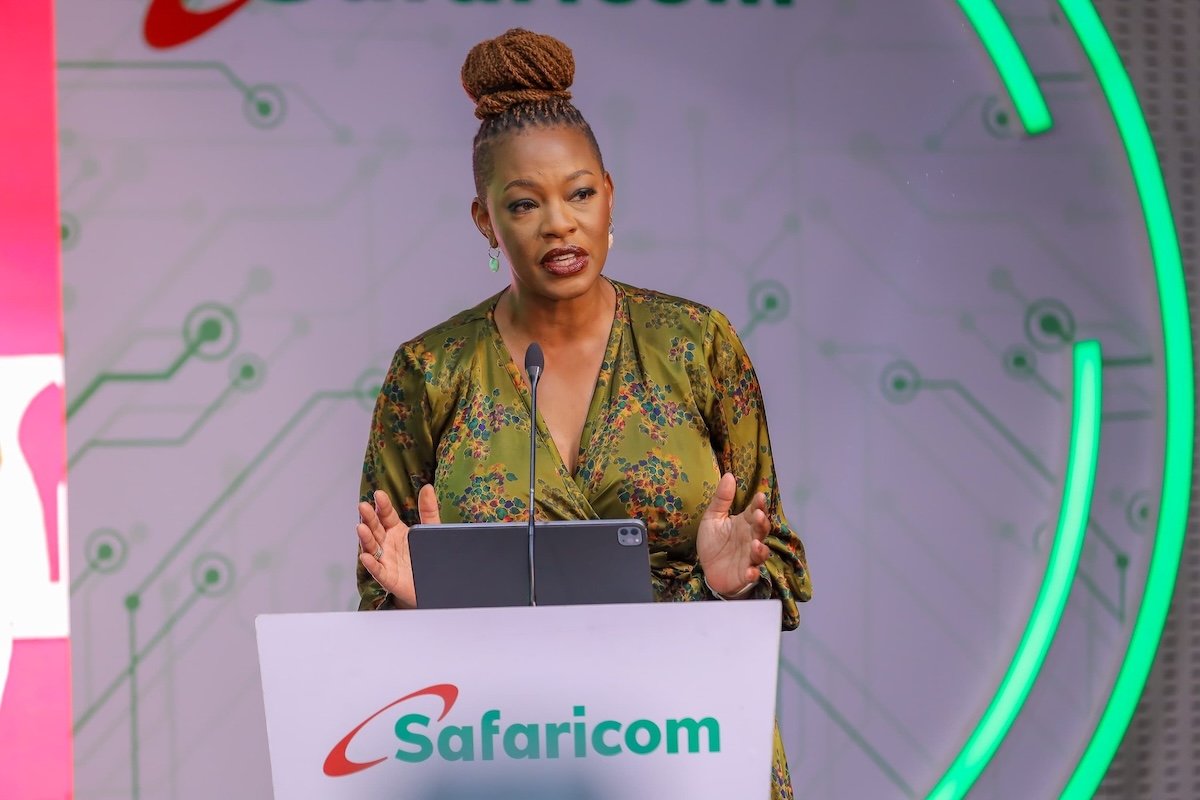
Esther Masese Waititu is leaving Safaricom. She has resigned as the company’s Chief Financial Services Officer and will exit on 31 July 2026, according to Business Daily, which first reported the move. Her departure ends a tenure that began in February 2023.
The timing stands out. She walks out on the same day Safaricom holds an Annual General Meeting that will formally hand more control to Vodacom, its new majority owner.
Here is what the job actually is, why her exit matters, and how it fits a pattern that has been building at Safaricom all year.
What the CFSO actually does
The Chief Financial Services Officer is not Safaricom’s accountant. The title is easy to confuse with a Chief Financial Officer, but the two roles are different. Waititu ran Safaricom’s financial services business. That means M-PESA and everything built on top of it. Payments. The Fuliza overdraft. Savings and lending products like M-Shwari and KCB M-PESA. Newer investment products such as Ziidi.

That division is now the engine of the whole company. We already broke down Safaricom’s full-year results, and the numbers are striking. In the year to March 2026, M-PESA brought in KES 182.7 billion. That was 45.6% of Safaricom’s Kenya service revenue, and the share is climbing by roughly 1.5 percentage points a year. Safaricom started life as a voice company. In revenue terms it is now close to being a financial services company that also sells airtime and data.
So the person running that unit sits near the centre of Safaricom’s growth story. Waititu held that seat for more than three years.
Who she is
Waititu is a career banker. She joined Safaricom in February 2023 from KCB Group, where she was Director of Corporate Banking. Before that she spent years at Standard Bank, known locally as Stanbic, and at Standard Chartered. She started out early in her career at what is now NCBA. She holds an MBA from the University of Liverpool.
At Safaricom, she oversaw the shift of M-PESA from a money-transfer tool into a broader financial platform. Her brief covered credit, insurance, savings and investments, not just sending cash.
A pattern, not a one-off
Waititu is the third senior Safaricom figure with a financial-services profile to leave within months. The other two went straight into banking.
In February, we covered Sitoyo Lopokoiyit’s move to Absa. Lopokoiyit ran M-PESA Africa and had earlier served as Safaricom’s financial services chief. He became Absa’s Chief Executive for Personal and Private Banking on 1 April 2026.
Then in July, we reported that Michael Mutiga, Safaricom’s Chief Business Development and Strategy Officer, was named Chief Executive of Stanbic Bank Kenya. He starts on 1 August 2026, subject to Central Bank of Kenya approval.
Waititu’s next stop has not been made public. It would be wrong to assume she is bank-bound. But the direction of travel for her recent colleagues is clear, and it points to a real shift in the market.
Banks are hiring from telcos and fintechs on purpose. Mobile money reshaped how Kenyans pay, borrow and save. M-PESA moved KES 41.68 trillion in the last financial year. Traditional lenders watched fintech-style products pull customers toward their phones and away from branches. Hiring the people who built those products is one way to catch up. That is the logic behind Absa taking Lopokoiyit and Stanbic taking Mutiga.
The Vodacom backdrop
Waititu leaves during the biggest ownership change in Safaricom’s history. On 30 June 2026, Vodacom lifted its effective stake to about 55% and took majority control. We explained the full structure of that deal, including the court battle that delayed it.
The 31 July AGM, the day Waititu leaves, is where that control gets written into Safaricom’s rulebook. Shareholders vote on 14 special resolutions requisitioned by Vodafone Kenya Limited. If passed, they let Vodacom nominate future CEOs, appoint a set number of directors, and settle boardroom deadlocks in its favour. The Kenyan government keeps a narrower set of protections over the brand name and any expansion outside Kenya and Ethiopia.
There is no public evidence tying Waititu’s resignation to the Vodacom deal. Executives leave for many reasons. What is true is that the leadership of Safaricom’s most valuable unit is changing hands at the exact moment the company’s owners are changing too.
What to watch
For M-PESA’s tens of millions of users, nothing changes on 31 July. The service runs as normal.
The open questions sit at the top of the house. Who takes over Safaricom’s financial services business, and whether that person comes from inside the company or from banking. Whether Waititu resurfaces at a lender, as two of her colleagues have. And how a Vodacom-controlled board treats the unit that now drives almost half of Safaricom’s Kenyan revenue. Those answers will tell you more about Safaricom’s next few years than any single resignation does.







Join the discussion