

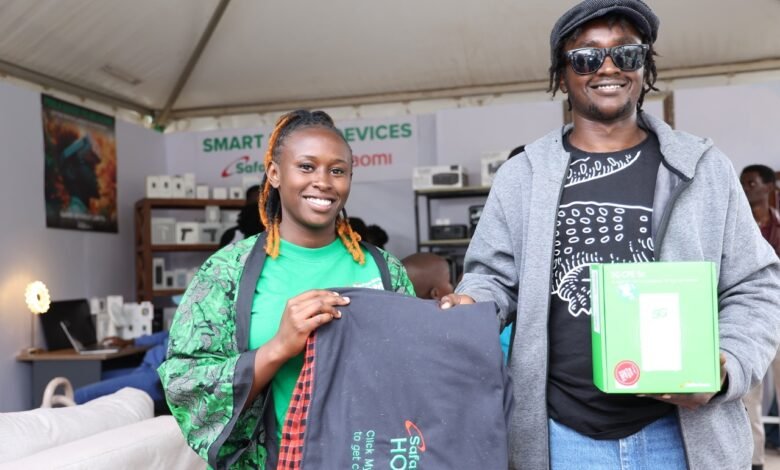
Safaricom held a Home Internet clinic in Avenue Park Phase 1, an estate in Embakasi, Nairobi. Residents could walk up to Safaricom staff and technicians, raise problems with their connection and ask about plans. Safaricom announced the clinic on 6th October 2026. It didn’t say which day it took place.
Home Internet is Safaricom’s name for the internet it sells to houses rather than to phones. Most of it comes in by fibre-optic cable, sold as Home Fibre. The rest comes through a 5G router in the house, which picks up the signal from a nearby mast the same way your phone does.
Normally, if your fibre is slow or keeps dropping, you call customer care, report the fault and wait for a technician to be sent out. A clinic turns that around: the technicians come to the estate, and you can put your question to someone who can answer it there and then. Hakim Ali, from Safaricom’s Home Segments team, said Avenue Park is “about 70 per cent connected by Safaricom”. He said the team had brought “experts and technicians who can respond to their concerns firsthand.” The 70% is his estimate. Safaricom doesn’t publish figures for individual estates.
Safaricom says the clinics are part of a wider push to visit estates across the country. It doesn’t say how many clinics have been held, which estate is next, or how residents find out one is coming.

Where Safaricom’s home fibre started
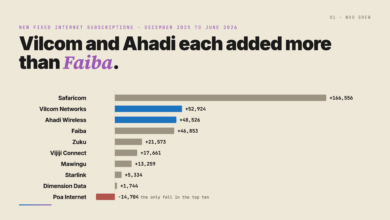
Safaricom’s first home fibre went into Nyayo Embakasi in July 2014, at 5 Mbps for KES 2,999 a month. Last month we covered how Safaricom went from fifth place that year to more fixed internet subscriptions than Faiba and Zuku combined, passing one million in June 2026.
Safaricom’s own count, in its annual report for the year to 31st March 2026, is 407,080 home customers, up 35.0% from 301,451 a year earlier. The report calls them FTTH (fibre to the home) customers in one place and fixed home customers in another. The second label is the accurate one, because the count includes homes on 5G. Funny, Safaricom has only 358,640 fibre customers across homes and businesses combined, fewer than the home figure on its own.
The fibre network itself passes 807,016 homes, 16.2% more than a year before. A home is “passed” when the cable runs close enough to connect it. The household still has to sign up. In Avenue Park, if Ali’s estimate is right, seven in ten have.
The speed upgrade happened in April
Safaricom also says Home Fibre speeds went up by “up to 2.5 times” at no extra cost. That change came on 29th April 2026, and we covered it when it arrived. Bronze went from 15 Mbps to 40 Mbps, still at KES 2,999 a month, so Bronze is about 2.7 times faster, more than Safaricom’s “up to” figure. Silver doubled from 30 to 60 Mbps at KES 4,100. Gold went from 80 to 150 Mbps at KES 6,299. Diamond (500 Mbps) and Platinum (1 Gbps) didn’t change.
So if you’re on Bronze, Silver or Gold, the faster speed should already be on your line. If a speed test still shows close to your old speed, something is holding it back. It could be the router, the Wi-Fi in a far room, or the fair usage limit. Since the end of April that limit has been 1.5 TB a month on Bronze, 2 TB on Silver and 5 TB on Gold, and once you use it up Safaricom slows the line until the next billing cycle. A technician at a clinic can check which one it is on the spot.
One resident, Paul Wanyoke, said he has used Home Fibre for about a year and a half and can connect several devices “and still enjoy good speeds.” What caught his eye was a portable router he could take with him when travelling. Safaricom didn’t name the router or give its price.
Who gets a clinic, and why Safaricom runs them
A clinic reaches one estate at a time, so most Safaricom customers won’t get one. For them, coverage checks, plan changes and Family Share on Home Fibre are still in My OneApp under Home Internet, or on *400#.
We think a clinic in an estate where Safaricom already has most of the homes is about keeping them. Customers who feel ignored are the ones a cheaper rival can win. Savanna Fibre, for one, sells 100 Mbps for KES 2,000 a month. Bronze costs KES 2,999 for 40 Mbps. Savanna’s coverage list in June didn’t include Embakasi, but it has been adding estates. A customer whose slow line was sorted out at a clinic has one less reason to switch if a rival’s cable reaches the estate.



Join the discussion